Jessica & PJ
Details
The Day Of
Schedule
Sunday, April 25, 2027
George Peabody Library
- 5:00 PMGatherExhibit HallJoin us for a refreshment before the ceremony
- 5:30 PMCeremonyReading RoomTie the knot
- 6:00 PMCocktail HourExhibit HallMerriment, libations and butlered hors d'oeuvres
- 7:00 PMReception & DinnerReading Room
- 8:30 PMDanceReading RoomBring your dancing shoes (or slippers)
- 8:30 PMSocialExhibit HallVisit with friends and family in a quieter space
- 11:00 PMSend-OffLibrary StepsSend Jessica & PJ off in style
Good Questions
FAQ
A Note on Love, Diversity & Community
At its heart, our wedding is a celebration of love, intentional community, and authentic joy. We are deeply grateful to bring together a room of people that reflects the full richness of our lives — spanning diverse racial, cultural, gender, and personal backgrounds. We want our wedding to be a place where all of our loved ones feel safe, honored, and celebrated for exactly who they are.
As a reminder, PJ uses they/them pronouns (e.g., "They look fantastic in that kilt!"). Whether pronouns and multicultural queer spaces are second nature to you or entirely new, all we ask is that every guest brings kindness, an open heart, and respect for one another. We want every single person in the room — from every walk of life — to feel cherished, celebrated, and ready to party!
What should I wear?
Dress Code: Formal & Festive (Tartans & Celtic Accents Welcome!)
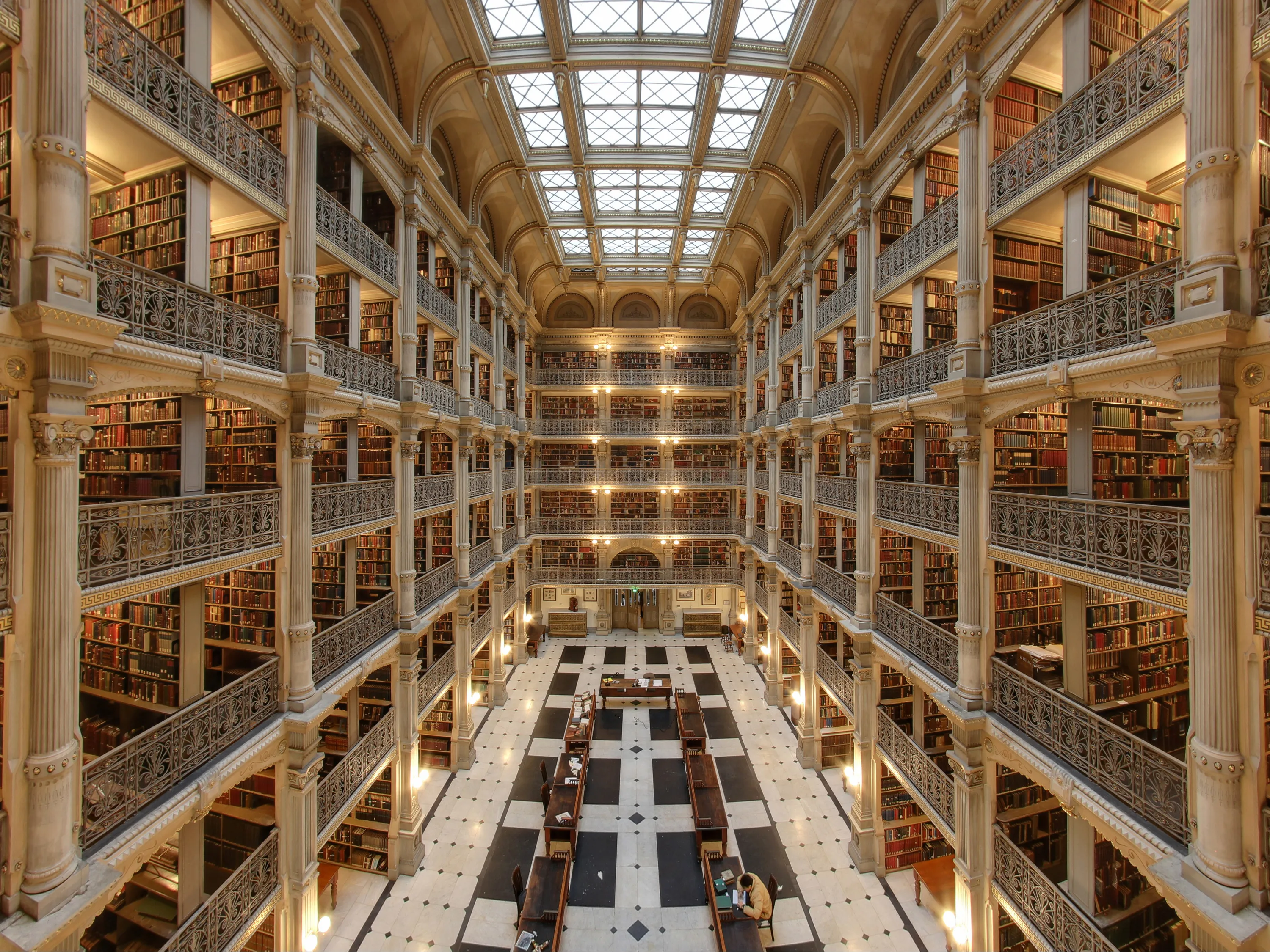
How often do you get to party under a 61-foot skylight surrounded by soaring cast-iron balconies
and 300,000 vintage books? Life doesn't give us nearly enough excuses for an experience like this.
We encourage everyone to embrace the grandeur of the historic 1878 George Peabody Library, dress
up, and celebrate in style with us!
- For Everyone: Floor-length gowns, elegant formal suits, dressy cocktail attire, tuxedos, dark suits with a tie, or formal kilts.
- A Celtic Twist: PJ will be wearing a formal kilt in the County Sligo tartan to honor the Farrell family's Irish roots. If you’ve been looking for an excuse to wear a kilt, your own family/county tartan, or a Celtic accessory (a brooch, tie, or wrap), consider this your official sign! We would love to see it.
Put on something that makes you feel fabulous and join us for an unforgettable night!
Is the venue accessible?
Yes, a separate accessible entrance is are available. Please reach out to the couple to arrange. The historic main entrance to the library is approximately 12 steps and has railings.
Can I bring a plus-one?
Plus-ones will be noted on individual invitations.
Why Baltimore and the George Peabody Library?
Baltimore holds a very special place in PJ’s heart! During their undergrad years at the Peabody Institute of Johns Hopkins University, PJ walked past this iconic library every single day — admiring its grandeur from the outside, knowing special events happened within, but never imagining they'd one day be getting married there.
When we started venue hunting, PJ threw out the idea of the library as a nostalgic "what if..." long shot, fully expecting it to be out of reach. But the moment we looked into it together, no other space even came close. What started as a fun, sentimental pipe dream quickly became the absolute dream location to celebrate with all of you!
What is the weather like in Baltimore in April?
Spring in Baltimore is beautiful! Expect crisp mornings and evenings in the mid-40s°F (7°C to 9°C), with pleasantly mild afternoons reaching the mid-60s°F (18°C to 20°C).
Because spring weather can be unpredictable, we recommend packing layers (a light jacket, sweater, or blazer) and a compact umbrella for occasional spring showers. If you plan to explore historic neighborhoods, bring comfortable shoes for brick and cobblestone sidewalks!
What's the best way to reach you with questions?
By Email: pj@mariska.dev or drpishney@gmail.com
The Cathedral of Books
George Peabody Library

George Peabody (1795-1869), often hailed as the pioneer of modern philanthropy, built his immense fortune as a merchant and international financier in 19th-century Baltimore and London. Driven by a deep conviction that wealth should be used to enrich society, he bestowed a landmark gift in 1857 to found the Peabody Institute of the City of Baltimore. Intended as a gift to the citizens of the city where he achieved his first major financial success, Peabody envisioned an institution that would cultivate intellectual and cultural life through a free public library, a music conservatory, an art gallery, and a public lecture series.
The realization of Peabody's vision for the library took physical form under the direction of Baltimore architect Edmund G. Lind, who designed the building in close collaboration with Dr. Nathaniel H. Morison, the Institute's first provost. Opening its doors in 1878, the library emerged as a breathtaking triumph of 19th-century architecture. Its central stack room was designed around a soaring atrium, framed by five tiers of intricately ornamental, gilded cast-iron balconies that rise dramatically 61 feet to a grand glass skylight — a majestic design that quickly earned the space its enduring nickname as a "cathedral of books."
The resilience of the library was put to a monumental test during the Great Baltimore Fire of February 1904, one of the most destructive urban blazes in American history. As raging flames swept through downtown Baltimore, consuming over 1,500 buildings and leveling vast swathes of the city's commercial heart, the Peabody Library stood safe in the historic Mount Vernon neighborhood just north of the path of destruction. Protected by a combination of favorable geography and its own robust, fire-resistant cast-iron structure, the library emerged unscathed, safeguarding its irreplaceable collections for future generations.
In 1977, the Peabody Institute formally affiliated with Johns Hopkins University, bringing the grand library into the university's family as part of the Sheridan Libraries system. Today, the George Peabody Library holds a unique and revered place within Johns Hopkins. It functions both as a vital academic research institution — housing over 300,000 volumes spanning history, art, architecture, and literature — and as one of the world's most celebrated, romantic venues, seamlessly bridging its rich 19th-century heritage with modern celebrations and scholarship.